
How to Search Cameron County Court Records
No single portal covers every public record in Cameron County. The County Clerk runs the official records portal for deeds, plats, liens, foreclosures, and commissioners court minutes. The District Clerk links several judicial tools for court case files, including a Tyler public portal, a Kofile quick link, the statewide re:SearchTX site, and iDocket for calendars. So the smart move is simple. First name the case type. Then pick the office and portal that match it.
The county pulls all of these tools onto one web portals page, which is a good place to begin when you are not sure where a record lives.
The county portals page lists the District Clerk, the County Clerk, the official records portal, the 1848 to 1912 historical records, the judicial public access portal, and iDocket. View it on the Cameron County web portals page to confirm you are using an official link.
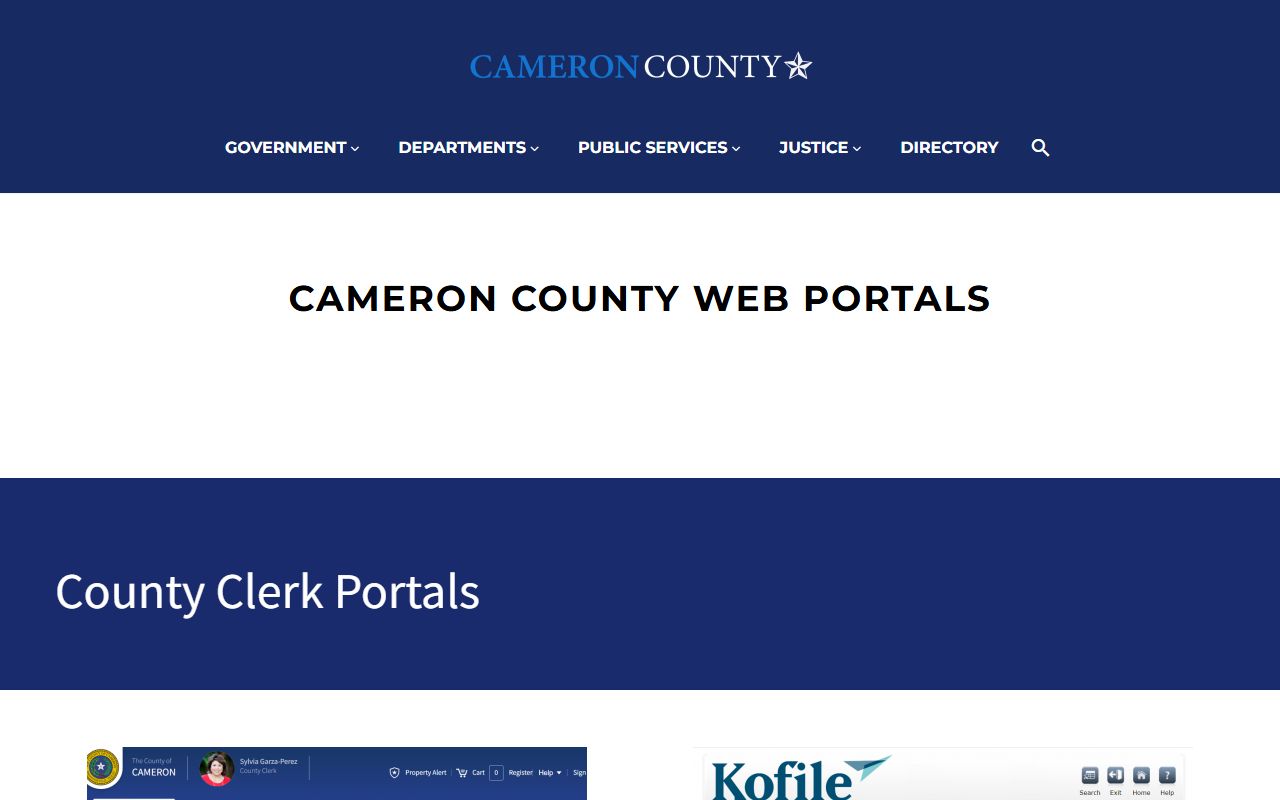
Because these tiles point only to county-approved tools, they are safer than a random search engine result for the same records.
- Decide the case type: official record, district court file, county court file, probate, or marriage record.
- For property and official records, open the County Clerk official records search and enter a name, document number, or document type.
- For a district or county court case, start at the District Clerk page and pick the Tyler portal, re:SearchTX, Kofile, or iDocket.
- Narrow your search by court, party name, or date range to cut down on common-name matches.
- Request a certified copy from the correct clerk if you need the record for legal use.
The Cameron County Judicial System
Texas uses a layered court system, and Cameron County reflects that model. At the top sit two state high courts. The Supreme Court of Texas hears final civil and juvenile matters. The Texas Court of Criminal Appeals hears final criminal matters. Below them are the intermediate courts of appeals. Cameron County appeals generally route to the Thirteenth Court of Appeals, based in Corpus Christi and Edinburg.
Trial courts do the day to day work. District courts handle felonies, divorce, family cases, larger civil suits, and juvenile matters. County courts at law handle misdemeanors and civil cases within set dollar limits. Probate courts handle estates and guardianships. Justice of the peace courts handle small claims, evictions, and fine-only cases. Municipal courts handle city tickets and ordinance cases.
Case flow: Justice Court › County Court at Law › District Court › Court of Appeals
The Texas Judicial Branch explains this whole structure in plain terms. See the Texas court structure page for the statewide chart.
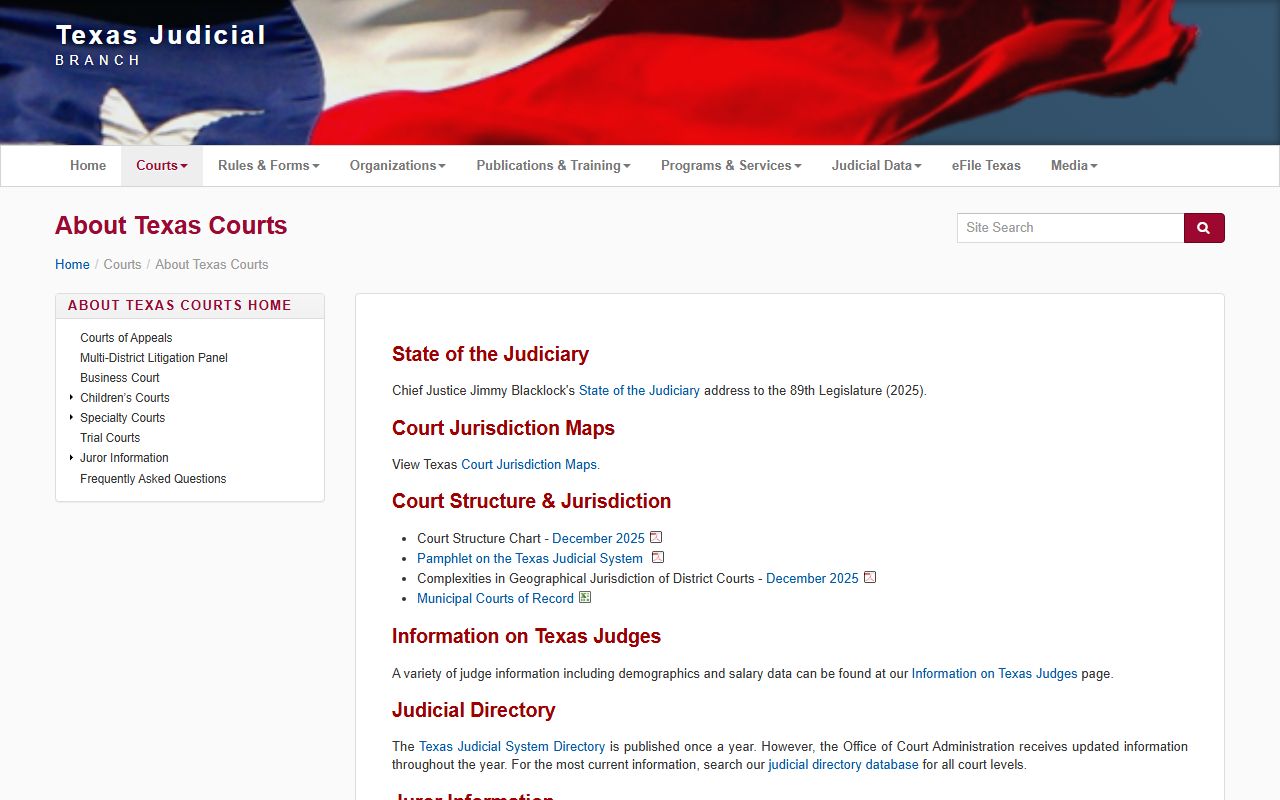
That chart helps explain why one Cameron County matter lands in district court while another stays in a county court at law or a justice court.
| Court | Jurisdiction | Case Types |
|---|---|---|
| District Courts | General trial court | Felony, divorce, family, child support, larger civil, juvenile |
| County Courts at Law | Limited by statute | Misdemeanor, civil over $5,000 up to $1,000,000, appeals from lower courts |
| Probate Court | Estates and guardianship | Wills, heirship, administration, guardianship |
| Justice of the Peace | Local, limited | Small claims, debt claims, evictions, fine-only misdemeanors |
| Municipal Courts | City limits | City ordinance, traffic, fine-only offenses |
District Clerk and County Clerk in Cameron County
Cameron County splits clerk duties between two offices, and this trips up many searches. The District Clerk supports the district courts and keeps district court civil and criminal files. Laura Perez-Reyes is the District Clerk. The office is the registrar, recorder, and custodian for cases such as felonies, divorces, workers compensation, adoptions, and child support. The District Clerk page reports roughly 7,300 cases filed and 9,000 disposed each year, with about 5,000 pending.
You can confirm the office and its case-search links on the official page.
The Cameron County District Clerk page lists the mission, departments, and direct phone numbers for civil, criminal, jury, records, and appeals.
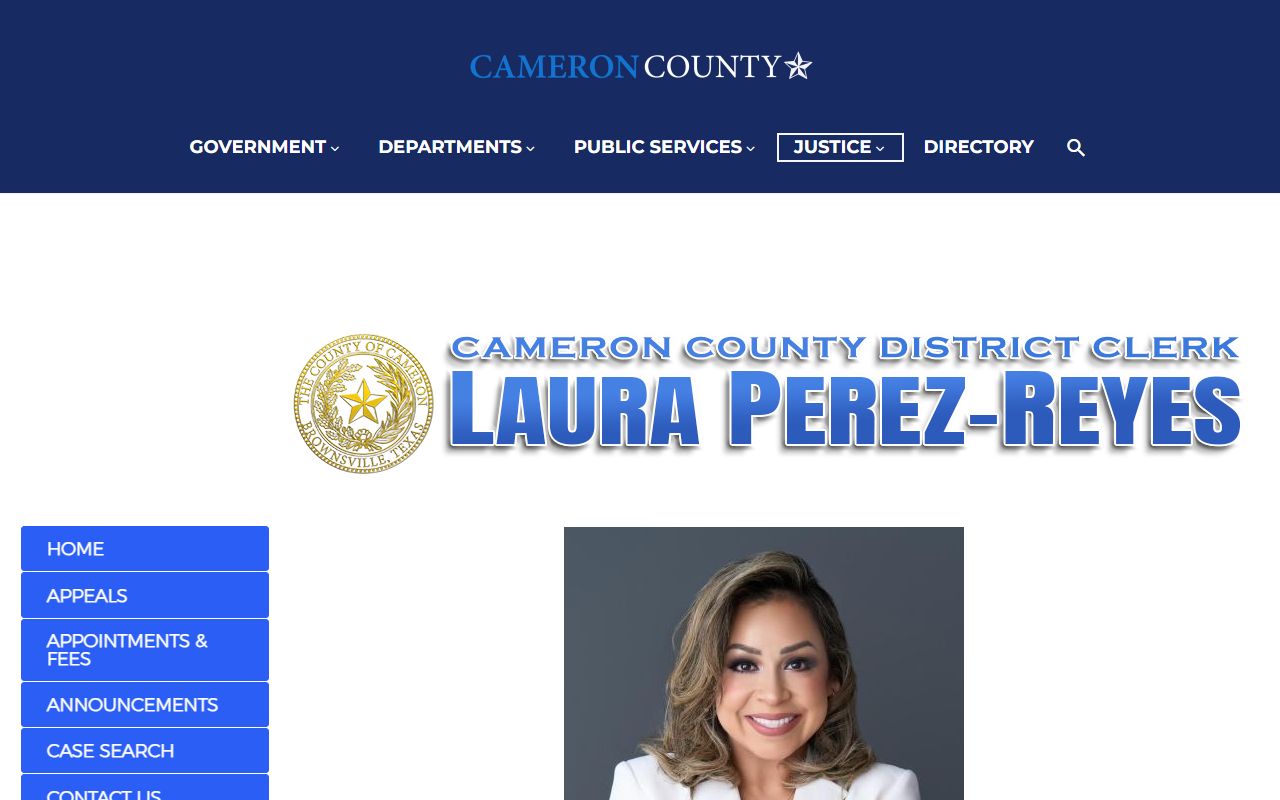
For divorce and felony district court files, this is usually the office that holds your record.
The County Clerk is Sylvia Garza-Perez. This office handles official public records, real property and land records, marriage licenses, vital statistics, county court at law civil and criminal records, probate filings, and commissioners court minutes. The County Clerk page notes that recording legal instruments is the office's most traditional duty and takes up the largest share of its work.
See the Cameron County Clerk page for services, public access tiles, and office contacts.
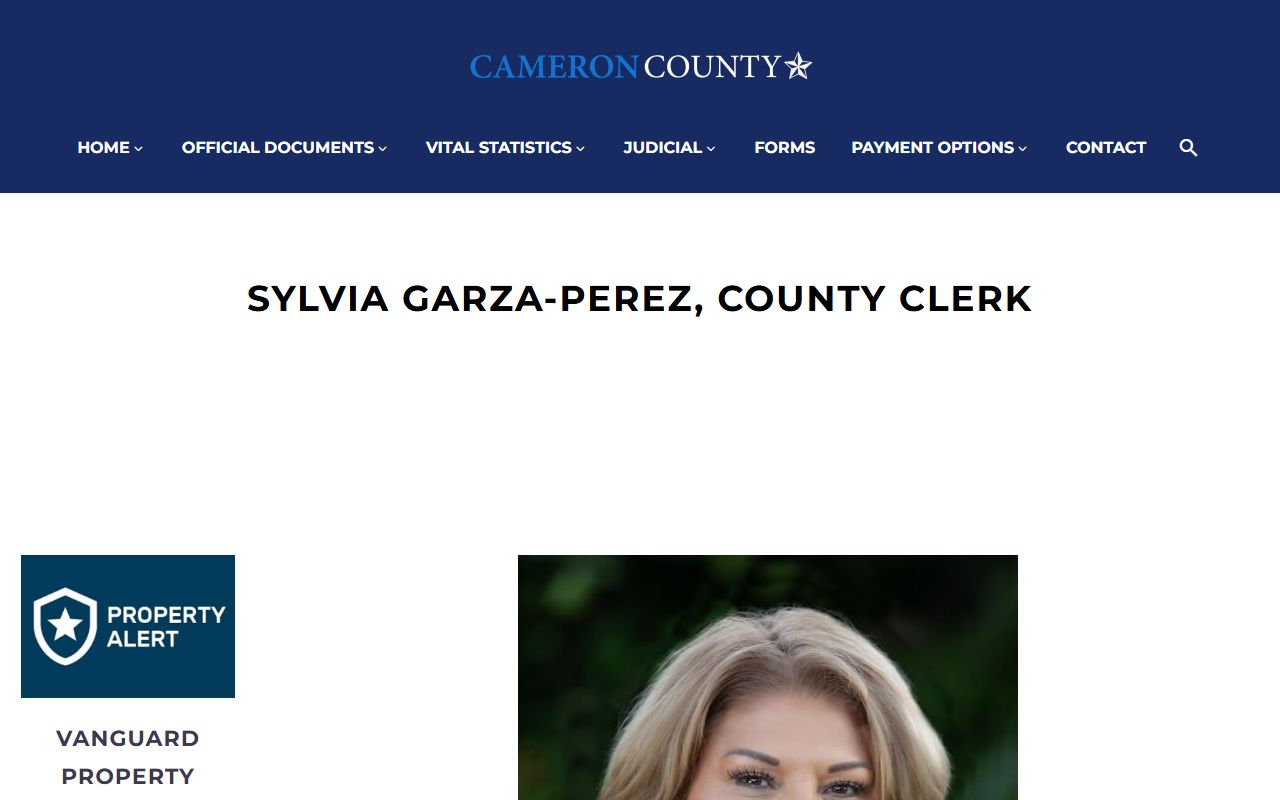
Choosing the wrong clerk is one of the most common reasons a Cameron County record search comes up empty. More detail sits on the District Clerk and County Clerk pages.
Types of Court Records Available in Cameron County
Cameron County court records cover a wide range of case types. Each type tends to live with a specific court and clerk. Knowing the split saves time and avoids dead ends. Most records are public, but some are sealed or confidential by law.
The list below shows the main record groups and where they sit.
- Criminal records - felony files at the District Clerk; misdemeanor county court at law files at the County Clerk.
- Civil records - district civil for larger suits; county civil for disputes over $5,000 up to $1,000,000.
- Family and divorce records - divorce, custody, and child support filed in district court.
- Probate records - wills, heirship, and guardianship through the County Clerk Probate Department.
- Traffic records - usually municipal or justice court files, by the issuing agency.
What Cameron County Court Records Show
A Cameron County court record is built from many fields. The exact set depends on the court and the case type. Most case files show who is involved, what was filed, when events happened, and how the case ended. Some details, like Social Security numbers and minor information, are redacted under state privacy rules.
The table below lists fields you will often see in a case summary or docket.
| Field | What It Shows |
|---|---|
| Cause Number | The court's unique case number, sometimes in a year-DCL-number format in district court. |
| Filing Date | When the petition, complaint, information, or application was filed. |
| Parties | Plaintiff and defendant, petitioner and respondent, or applicant and decedent. |
| Charges / Cause | The offense, claim, or relief requested. |
| Disposition | The outcome: dismissed, judgment, plea, sentence, or pending. |
| Docket Entries | A dated list of motions, orders, hearings, and notices. |
Public Access Laws for Cameron County Court Records
Public access in Texas is broad but not absolute. County offices such as the sheriff and commissioners court fall under the Texas Public Information Act. Court case files are treated differently and follow rules set by the courts. So a request for jail body camera footage is a public information request, while a request for a case file goes through the clerk's records process. The responsible office may ask for a written request, a copy fee, or a court order for restricted material.
A few statutes shape how these records are released and what stays private.
Key Statutes:
Texas Government Code § 552.001 - sets the state's policy in favor of open government records unless the law says otherwise.
Texas Government Code § 552.0035 - says access to judicial records follows rules set by the Supreme Court of Texas, not the open records act.
Code of Criminal Procedure Chapter 55 - governs expunction, which can remove qualifying arrest and court records.
Government Code Chapter 411 - allows orders of nondisclosure that limit who can see qualifying criminal history.
Records That Are Restricted or Confidential
Some Cameron County records are closed to the general public. Juvenile records are restricted under the Texas Family Code. Adoption records are confidential and usually need a court order. Sealed civil records follow Rule 76a, which requires a motion, notice, and a hearing. Expunged and nondisclosed criminal records are limited by statute after the order is granted. Mental health and medical records are protected, and the jail will not release inmate medical details to family.
To view a sealed record, a person with standing usually must file a motion in the court that holds the case. The court weighs privacy and safety against the public's right to know. The District Clerk lists an expunction contact for criminal cases, and the County Clerk handles its own criminal expunction requests.
Specialty Courts in Cameron County
Cameron County runs problem-solving court programs that focus on treatment instead of jail. The Texas Judicial Commission on Mental Health lists a Cameron County Mental Health Divert Court serving Cameron and Willacy counties. The state specialty-court registry also lists a Cameron County veterans court tied to the 444th District Court. These programs use court supervision, treatment plans, and regular check-ins.
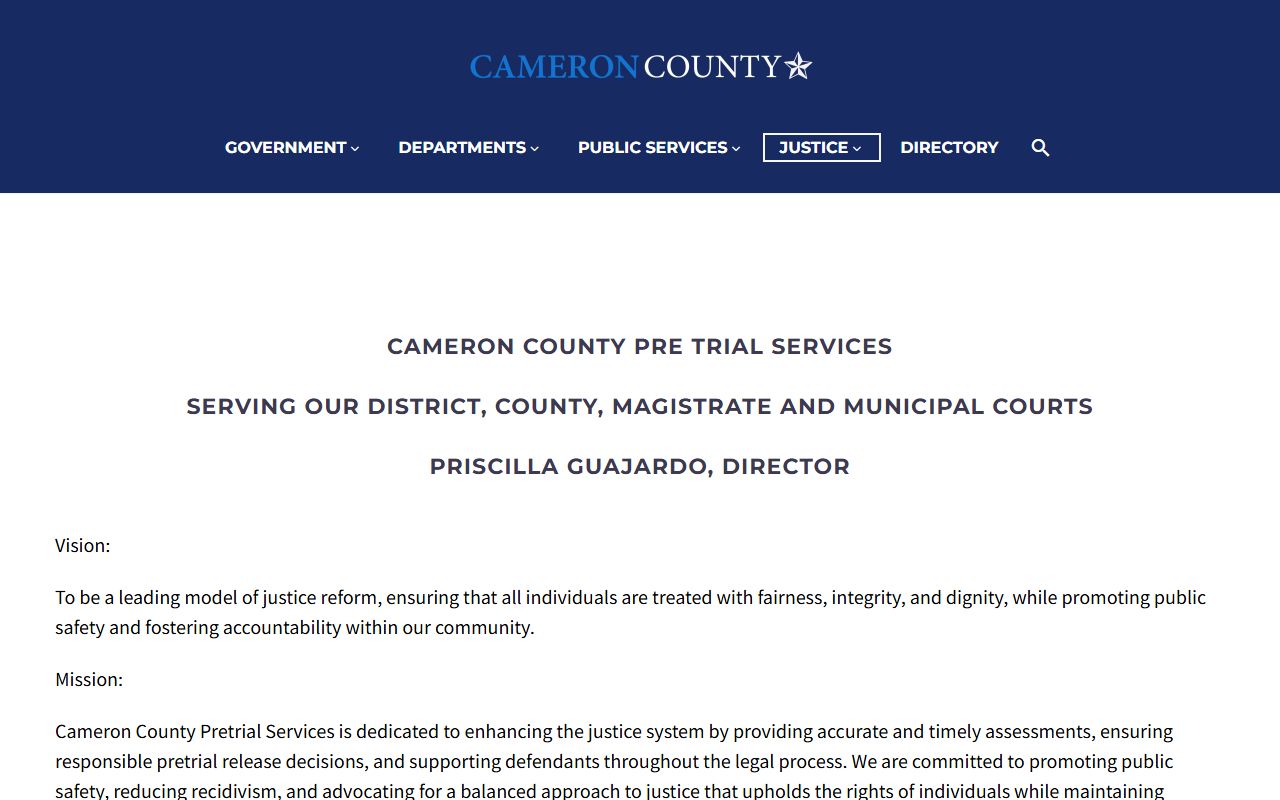
Pretrial Services supports this work from the other side. The office screens defendants for court-appointed attorneys and serves district, county, magistrate, and municipal courts.
Read more on the Cameron County Pretrial Services page, which covers indigent defense screening and required documents.
For arrest and prosecution detail, see the Cameron County arrest records page.
Cameron County Sheriff and Jail
Sheriff Manuel "Manny" Treviño leads the Cameron County Sheriff's Office. The office runs the county jail system and posts a public inmate list. That roster is not comprehensive. It covers people held now and within the last seven days, excludes federal prisoners and detainees, and updates every two hours. Visible columns are picture, booking date, defendant, booking number, SO number, and charges.
The roster, the docket, and warrant status are not interchangeable. A booking may show before a case is filed, and a warrant may show after a person leaves the jail. Use the full Cameron County inmate records page for the roster details and the warrant records page for active warrant guidance.
Marriage, Divorce, and Probate Records
Marriage licenses and certified marriage copies are County Clerk records. Divorce records are district court files kept by the District Clerk. Probate runs through the County Clerk Probate Department. Each has its own request path. See the marriage and divorce records page and the probate records page for forms and fees.
Probate uses a few terms worth knowing before you read a file.
- Testator
- The person who makes a will.
- Executor
- The person named to carry out the will and settle the estate.
- Conservator
- A person a court names to manage another person's care or property.
Cameron County Court Records Fees
Copy fees depend on the clerk and the document. The County Clerk Civil-Probate request form lists plain copies, certified copies, and a search fee. These amounts come from official county forms and the 2026 fee schedule. Always confirm the current amount before you mail a payment.
| Item | Amount |
|---|---|
| Plain copy per page | $1 |
| Certified copy | $5 plus $1 per page, per document |
| Records search | $5 |
| Letters | $2 each |
| Certified marriage record | $21 per copy |
Note: A certified copy is an official copy issued by the clerk for legal use, while a plain copy is fine for personal review.
Cameron County Courthouse and Contact
The working courthouse for court records is in central Brownsville. District courts, county courts at law, probate, and the court-facing clerk departments operate from the judicial building on East Harrison Street. The County Clerk's main official records office sits a few blocks away on East Levee Street, so land records and court files are at two different addresses.
Cameron County Courthouse / Judicial Building
974 E. Harrison St.
Brownsville, TX 78520
District Clerk Records: (956) 574-8130
Cameron County Clerk Main Office
835 E. Levee St., 3rd Floor
Brownsville, TX 78520
(956) 544-0815
The county homepage is the hub for every department and portal.
Start at the Cameron County official homepage when you need a department phone or a service you cannot place.
From there you can reach the District Clerk, County Clerk, Sheriff, and the courts in a few clicks.
History of Cameron County Courts
Cameron County is the southernmost county in Texas, and Brownsville is the county seat. The 2020 census counted 421,017 residents, and the 2024 estimate was 431,874. The county's court system serves a border region with international bridges, a port, coastal tourism, and a large bilingual population. The older courthouse, often called the Dancy Building, dates to the 1912 to 1914 period and stands on East Madison Street. Active trial courts now work from the East Harrison judicial complex, which is the address most record users need today.
Frequently Asked Questions
Where do I search Cameron County court records?
Start with the case type. District court cases begin at the District Clerk page and its links to the Tyler portal, re:SearchTX, Kofile, and iDocket. County Clerk records, including official records, probate, county civil, misdemeanors, and marriage records, begin at the County Clerk page. For current jail custody, use the Sheriff's inmate list, not a court portal.
What is the difference between the District Clerk and the County Clerk?
The District Clerk keeps district court files such as felony, divorce, family, child support, and larger civil cases. The County Clerk keeps official records, marriage and vital records, probate, and county court at law civil and criminal cases. Picking the wrong office is a common reason a search fails.
Are Cameron County inmate records online?
Yes, in part. The Sheriff posts a public inmate list that updates every two hours. It is not comprehensive and excludes federal prisoners and detainees. See the inmate records page for how to read and verify it.
More answers are on the Cameron County court records FAQ page.