
How to Search Cameron County Traffic Court Records
There is no single countywide traffic-ticket portal in Cameron County. The county pages reviewed do not show one unified citation search for every court. That is why the search must start with the citation itself. The ticket should name the court, the court address, the citation number, the offense, the appearance date, and the payment or contest instructions. If the citation came from a city police department, use that municipal court. If it came from a constable, sheriff, DPS trooper, or county officer, check the justice of the peace precinct or the court named on the ticket. A county court at law misdemeanor may show in County Clerk records or an iDocket calendar.
Before you search, gather a few items. Have the citation number, the driver name, the offense date, and the court name from the ticket. A citation number is the fastest path because it points to one case. A name search can return several matches in a county this size, so keep a date in mind to narrow it. If the case has become a warrant or a county-court misdemeanor, do not assume online payment is still open.
- Read the citation and find the named court and the citation number.
- Open that court's page: a city municipal court, a JP precinct, or the County Clerk side for a county-court misdemeanor.
- Search by citation number, or by driver name with an offense date to narrow it.
- Review the charge, court date, fine, and disposition shown for the case.
- Pay through the official court channel, contest by the deadline, or request a certified copy from the clerk.
Which Courts Handle Traffic Cases in Cameron County
Traffic routing in Cameron County depends on the issuing agency and the offense level. Fine-only municipal citations belong to the city court for the town that issued the ticket, such as Brownsville, Harlingen, San Benito, South Padre Island, Port Isabel, La Feria, or Los Fresnos. Fine-only state-law citations written outside city court jurisdiction may be filed in a justice of the peace court. Class A or B misdemeanor traffic offenses can become county court at law criminal records handled by the County Clerk. Felony cases such as intoxication assault, intoxication manslaughter, or repeat felony DWI are district court matters handled by the District Clerk.
Municipal courts are city courts, not county clerk offices. A ticket from Brownsville Police normally belongs to Brownsville Municipal Court, and a beach-area citation on South Padre Island may belong to that city's court. County-level portals may not show municipal cases at all, so the rule stays the same: look at the court named on the citation.
| Court | Traffic Cases Handled | Address |
|---|---|---|
| Municipal Courts | City fine-only Class C traffic and ordinance offenses written by city officers | Each city, such as Brownsville, Harlingen, San Benito, Port Isabel |
| Justice of the Peace Courts | Fine-only state-law citations, some traffic, small claims, and magistrate functions | By precinct and place across Cameron County |
| County Courts at Law | Class A and B misdemeanor traffic offenses, such as some DWI-related cases | 974 E. Harrison St., Brownsville, TX 78520 |
| District Courts | Felony intoxication assault, intoxication manslaughter, and repeat felony DWI | 974 E. Harrison St., Brownsville, TX 78520 |
Types of Traffic Cases on Record
Traffic cases cover more than speeding. The record can be a moving violation, a non-moving or equipment violation, a parking or code matter, or a commercial driver offense. Most are fine-only Class C cases in a municipal or justice court. A few rise to misdemeanor or felony level when alcohol, injury, or a repeat offense is involved, and those leave the traffic track for the criminal courts.
- Moving violations - speeding, running a light or stop sign, and unsafe lane changes written as fine-only citations.
- Non-moving and equipment - expired registration, no insurance proof, or equipment defects.
- Parking and code - city parking and code enforcement matters handled by municipal courts.
- Commercial vehicle and CDL - offenses by commercial drivers, which carry stricter rules and reporting.
- Photo enforcement - Texas law has restricted red-light camera programs, so verify whether any local civil camera program still exists.
Note: A crash report is separate from a traffic court file and is obtained through law enforcement or the Texas DPS crash report system.
What Cameron County Traffic Court Records Show
A traffic court record holds the case facts, the plea, and the outcome. It can show the citation number, the driver name, the offense date and time, the offense and statute or ordinance, the issuing agency, and the court date. Public displays often redact the driver license number, the full date of birth, and vehicle details under state privacy rules. The disposition line is the one most people want, because it tells you whether the case was paid, dismissed, deferred, or turned into a warrant.
| Field | What It Shows |
|---|---|
| Citation Number | The ticket or case number used to find the file fastest. |
| Charge / Statute | The offense description and the statute or city ordinance cited. |
| Issuing Agency | The police department, constable, sheriff, or DPS officer who wrote the ticket. |
| Court Date | The appearance or hearing date set by the court. |
| Plea | Guilty, no contest, or not guilty entered by the driver. |
| Disposition | Paid, dismissed, deferred, driver safety course, conviction, failure to appear, warrant, or capias pro fine. |
| Fine and Costs | The fine, court costs, collection fees, and any payment-plan status. |
| CDL Flag | Whether the driver holds a commercial license, which changes the rules. |
Searching by Citation Number vs by Name
The citation number is the cleaner search. It points to one case and avoids common-name confusion. A name search can be useful when the ticket is lost, but it may return several drivers with the same name. Adding an offense date helps. Citation number format errors are a frequent problem, so copy the number exactly from the ticket, including any leading letters or zeros. Some court portals also ask for a driver license number or a date of birth to confirm identity.
| Search Field | Type | Required | Notes / Format |
|---|---|---|---|
| Citation Number | Text | No | Best single search; copy it exactly from the ticket. |
| Driver Name | Text | No | May return several matches; pair with a date to narrow. |
| Offense Date | Date | No | Helps separate drivers who share a name. |
| Driver License Number | Text | No | Some portals use it to confirm identity; often redacted in results. |
Paying or Contesting a Cameron County Traffic Ticket
Use the official court payment channel only. County Clerk and county court pages link online payment options for some case types, while municipal courts may use separate payment vendors. Some citations are payable without a court appearance. Others require you to appear, especially juvenile cases, CDL-related matters, alcohol or drug offenses, and crashes with injury. Check the citation and the court instructions before you assume online payment is open.
You can plead guilty, no contest, or not guilty. Paying the fine usually counts as a guilty or no-contest plea, which can become a conviction on your driving record. To contest, enter a not-guilty plea by the deadline and request a trial or hearing under that court's rules. If you want a deferred disposition or a driver safety course, ask for it before you pay as a conviction.
- Read the citation and identify the named court.
- Confirm whether the offense is payable without an appearance.
- If paying, use only the official court payment channel.
- If contesting, enter a not-guilty plea by the deadline and request a hearing or trial.
- If seeking deferred disposition or a driver safety course, request it before paying as a conviction.
- If the deadline passed, contact the court at once about any warrant, capias, OmniBase hold, or added fees.
- After resolution, confirm the court reports the correct disposition to DPS.
Note: Missing a traffic court date can lead to a warrant, a capias pro fine, added fees, or a license hold, so contact the court right away if a deadline has passed.
Public Access Laws for Traffic Court Records
Traffic court records are court records, so access follows court rules rather than the open records act alone. County administrative records fall under the Texas Public Information Act, but case files follow the judiciary rules under Government Code Section 552.0035. Traffic records add a privacy layer because motor vehicle and driver data is protected. The court may ask for a written request and a copy fee, and some fields stay redacted in any public copy.
Key Statutes:
Texas Government Code § 552.130 - protects motor vehicle record information, including license, title, and registration data.
Texas Government Code § 552.0035 - says access to court records follows rules set by the Supreme Court of Texas, not the open records act.
Court Traffic Records vs State Driver Records
These are two different files, and people mix them up often. The court traffic record is the local case file for one citation. It is held by the municipal court, JP court, County Clerk, or District Clerk, depending on the offense. The Texas driver record is a separate file kept by the Texas Department of Public Safety. It shows license status and convictions reported to DPS, not the full court file. Paying a ticket does not always clear a license hold, because the hold is a driver-record issue that the court must report cleared.
| Feature | Court traffic record | Texas driver record |
|---|---|---|
| Maintained by | Municipal court, JP court, County Clerk, or District Clerk depending on offense or court | Texas Department of Public Safety driver license record system |
| Main identifier | Citation or ticket number, case or cause number, defendant name, court | Driver license number, date of birth, name |
| Shows | Charge, statute or ordinance, plea, court date, fine and costs, deferral or driver safety course, warrant or FTA, disposition | License status, convictions reported to DPS, crashes or suspensions where applicable, CDL reporting, points or surcharge history where relevant |
| Does not show | Complete statewide driving history unless reported; license administrative status may be absent | Full court file, pleadings, local docket entries, bond or warrant details in a local case |
| Copy source | Court clerk for the court that handled the citation | Texas DPS driver record request portal |
To pull a statewide driving history, the Texas DPS driver record portal asks for license or ID details and a payment. View the Texas DPS driver record order page to request your official driver record.
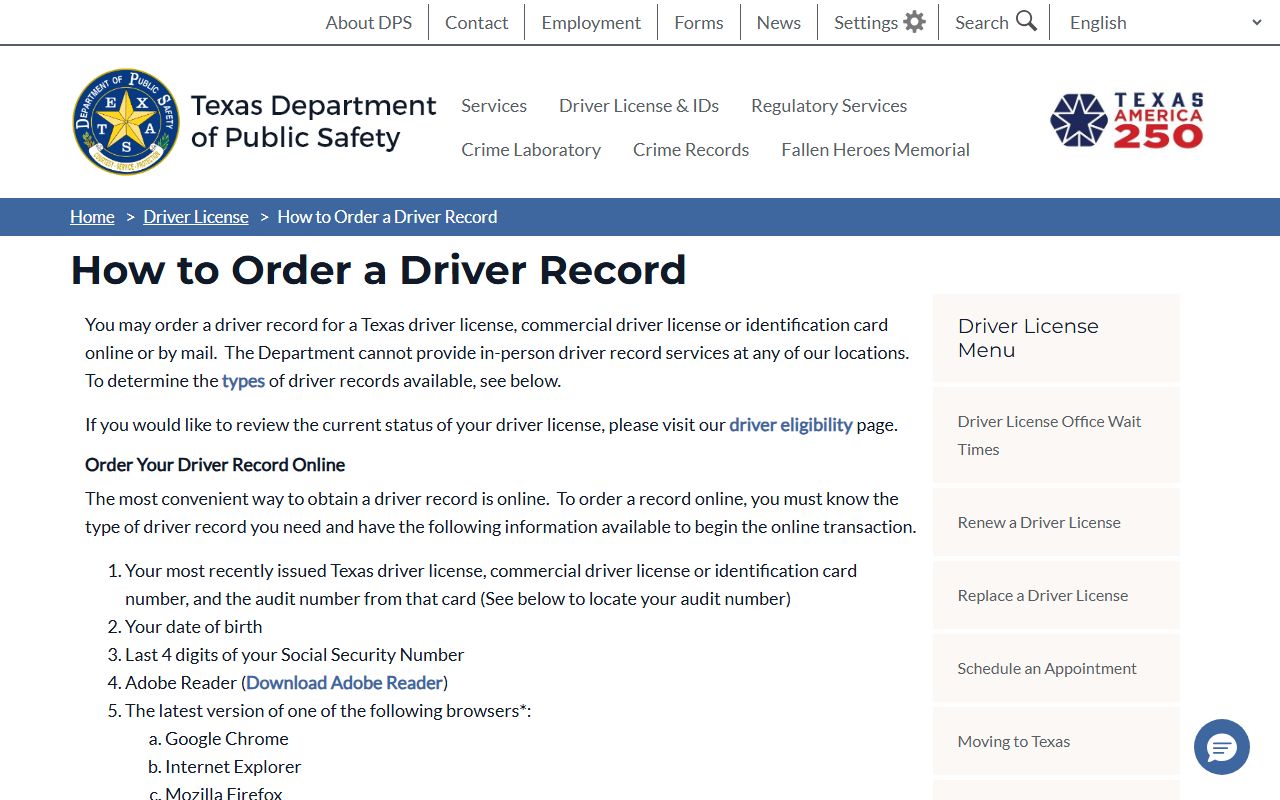
Because the DPS driver record is separate from a Cameron County court file, you may need both to see the full picture of a citation.
CDL and Commercial Driver Records
Commercial drivers face stricter rules. CDL holders often cannot mask convictions through deferred disposition or a driver safety course the way other drivers can. Texas Transportation Code Chapter 522 governs commercial licenses and the disqualification and reporting consequences tied to them. A CDL conviction is reported and can affect the driver's livelihood, so many CDL traffic matters require a court appearance rather than a simple online payment. If the citation involves a commercial vehicle, read the court instructions carefully and consider legal advice before pleading.
DUI / DWI Cases
DWI is not an ordinary traffic ticket. It is a criminal case, and it routes to the county courts at law or the district courts depending on the level. A first or second DWI is usually a misdemeanor handled by the County Clerk side, while felony intoxication offenses go to the District Clerk. These cases involve booking, bond, and a criminal docket, not a fine-only traffic process.
For full Cameron County DUI/DWI case information, see Cameron County criminal records.
Deferred Adjudication and Defensive Driving Course
A deferred disposition or a driver safety course can keep a fine-only conviction off the driving record. Eligibility depends on the offense, the driving history, the CDL status, and court approval. You usually must request it before paying the ticket as a conviction, because paying first can lock in the conviction. A driver safety course often carries a course fee plus a reduced court cost. CDL holders may not qualify for the same options, so ask the court what is available for your case.
Sealing or Expunging Traffic Records
Texas uses expunction and nondisclosure for criminal records, and a fine-only traffic case can sometimes qualify. Expunction under Code of Criminal Procedure Chapter 55 may reach a qualifying dismissed or acquitted case. Nondisclosure under Government Code Chapter 411 limits public release for some outcomes. A simple paid Class C citation is usually a final conviction and is generally not eligible for expunction. For the eligibility detail and the local expunction contacts, the Cameron County arrest records page covers both remedies.
Fees for Traffic Record Copies
Copy fees depend on the clerk and the document. The County Clerk request form lists a search fee, plain copies, and certified copies. A certified copy is an official copy issued by the clerk for legal use; a plain copy is fine for personal review. Municipal courts set their own copy fees, and the state charges separately for a driver record. Always confirm the current amount before you mail a payment.
| Item | Amount |
|---|---|
| Plain copy per page | $1 |
| Certified copy | $5 plus $1 per page, per document |
| Records search | $5 |
| State driver record | Set by Texas DPS; payment required at the DPS portal |